

How Holiday Park Management Software Brings Every Daily Operation Into One Place

Running a holiday park becomes harder when every department relies on a different system.
Bookings sit in one platform. Owner records sit in spreadsheets. Activity sessions are managed separately. EPOS reports need reconciling. Housekeeping receives a printed list. Marketing depends on someone remembering to export guest data.
Holiday park management software brings those daily operations into one place.
Your team works from the same data, managers get a clearer view of performance, and you spend less time moving information between disconnected tools.
No commission. No setup fee. No per-user charges. Everything included from day one.
One platform reduces daily admin
A fragmented software setup creates repeated work.
A booking is entered into one system, then copied into a calendar. An owner invoice is prepared from a spreadsheet. A departure list is sent to housekeeping manually. Activity bookings are checked against a separate list. Sales and guest information are exported before a campaign can be created.
Each individual task may only take a few minutes. Across a busy week, the total cost is much higher:
- More manual entry.
- More opportunities for errors.
- More time checking whether information is up to date.
- More staff dependency.
- Less confidence in reports.
With Parkcore, the booking, owner, activity, EPOS, guest, maintenance and reporting functions sit within one platform. Your team can manage the work from connected records instead of repeatedly transferring data between systems.
Manage the full booking lifecycle in one view
Booking management is the operational starting point for most parks. It affects arrivals, departures, housekeeping, availability, guest communication and revenue reporting.
Parkcore lets your team manage the full booking lifecycle:
- Provisional.
- Confirmed.
- Checked-in.
- Departed.
Date range filters and unit selectors help reception find the right information quickly. Email confirmations keep guests informed. CSV exports provide a practical way to review or share data when needed.
The four-week availability calendar gives your team a clear view of the park without requiring several separate searches. Staff can see availability across units, select a booking and manage it directly from the calendar.
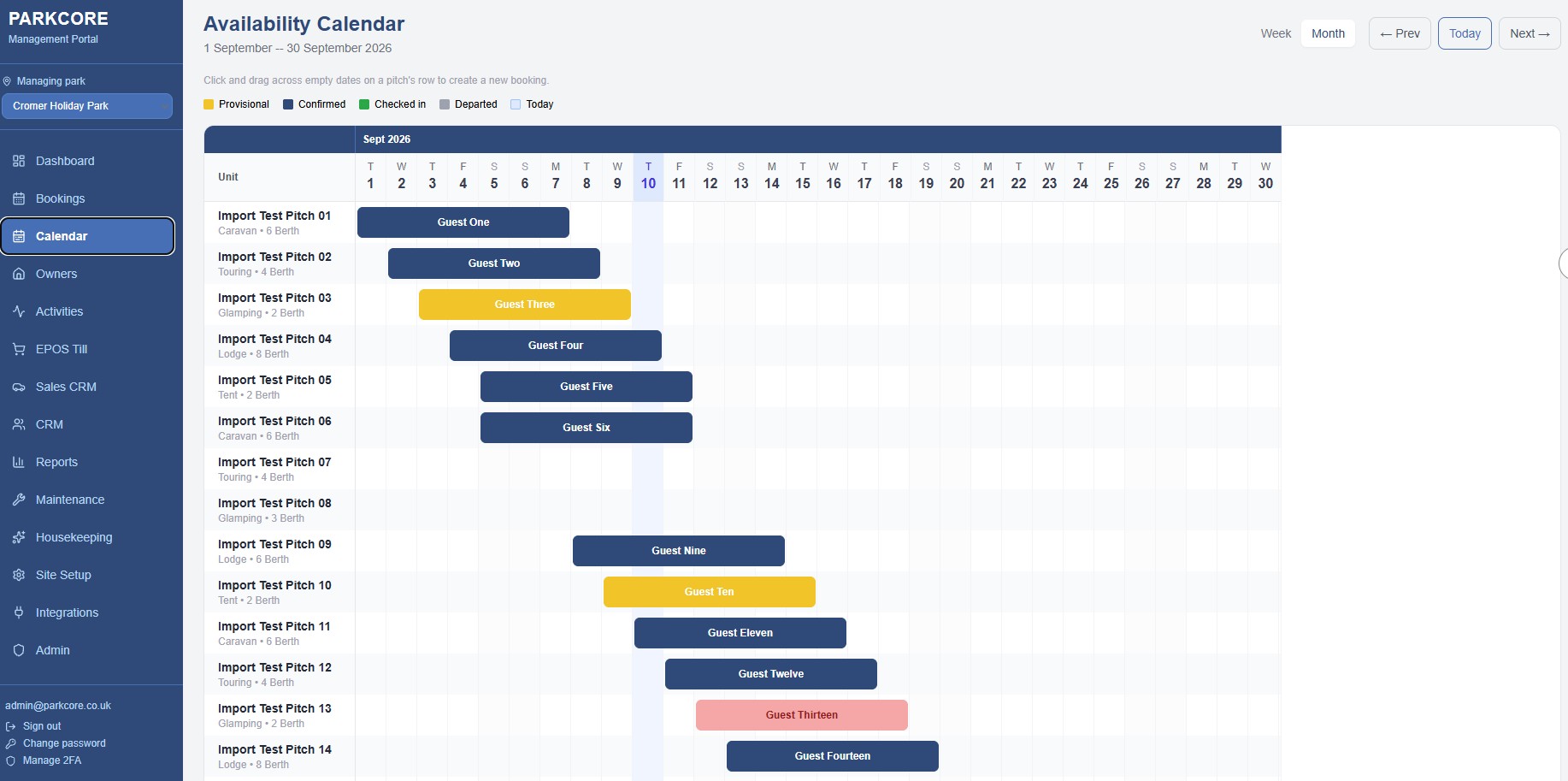
This matters during busy periods. A receptionist answering a phone enquiry should not need to open multiple screens to check whether a unit is available for a particular date range. A clear calendar reduces those repeated clicks and helps your team answer with confidence.
For more detail, read The Four-Week Calendar: Why Your Availability View Matters More Than Your Booking Form.
Connect arrivals and departures to housekeeping
Housekeeping should not depend on a manually prepared list that may be out of date before the day begins.
Parkcore automatically generates morning housekeeping schedules from that day’s departures. Your team can view the tasks, mark them as complete and reopen them if a unit needs further attention.
That gives housekeeping a direct operational link to bookings. When a departure is recorded, the cleaning requirement is visible. When the task is completed, the team has a clear record of progress.
This helps reduce:
- Manual list-building.
- Missed cleaning tasks.
- Unclear responsibility.
- Phone calls between reception and housekeeping.
- Delays caused by outdated information.
The system also includes maintenance job cards. Staff can log a job against a unit, assign it to themselves or a colleague, track parts used and close the request with a running job number.
Instead of keeping maintenance requests in messages, notebooks or memory, your team has a structured record of what needs doing and what has already been completed.
Read more about maintenance job tracking when one person does everything.
Keep owner records, invoices and payments together
Owner administration is another area where disconnected systems create unnecessary work.
Parkcore stores owner records alongside pitch assignments and membership tiers. Your team can create site fee invoices, track payments and produce PDF or CSV statements without rebuilding the information from separate files.
That gives you one place to check:
- Which pitch is assigned to which owner.
- Which membership tier applies.
- What has been invoiced.
- What has been paid.
- Which statement needs to be issued.
The benefit is not just faster administration. It is greater consistency. When owner details, assignments and financial records are connected, your team is less likely to work from an outdated spreadsheet or issue an invoice using old information.
See why owner invoicing on a spreadsheet creates an admin burden.
Run activities and EPOS from the same system
Activities create their own operational demands. You need to set opening hours, generate sessions, manage blocked dates, notify guests and check attendance.
Parkcore allows your team to set opening hours for each activity and automatically generate sessions from the schedule. If a date needs to be blocked, you can close it and notify affected guests. QR code check-in provides a straightforward way to record attendance.
Your on-site EPOS till is also included. Staff can manage product grids, baskets, VAT breakdowns, receipt printing, void transactions and daily journal reporting.
That means your park can manage accommodation activity and on-site sales through the same platform rather than combining separate reports at the end of the day.
The result is a clearer view of the business:
- Booking revenue.
- Activity revenue.
- EPOS sales.
- VAT breakdowns.
- Daily reporting.
- Stock alerts.
No separate EPOS subscription. No additional charge for every member of the team using it.
Use guest data without exporting spreadsheets
A guest database becomes more useful when it is connected to booking history and consent records.
Parkcore’s guest CRM gives your team a searchable view of guest details, stay history, preferences, sources, tags and marketing consent. You can segment guests based on the information already held in the platform.
For example, you can identify:
- Guests who have not stayed for six months.
- Guests who have visited during a particular season.
- Guests with a recorded preference or tag.
- Guests who have consented to marketing.
- Guests who have booked through a particular source.
You can then build an email campaign, preview who it will reach and track delivery. You do not need to export a list, clean it in another tool and upload it again.
Marketing automation handles repetitive reminders such as win-back campaigns, stay anniversaries and pre-season messages. Parkcore checks eligibility daily and sends according to the rules you set.
It does not replace personal communication. It removes the need to remember every routine campaign manually.
Read how automated guest emails work without a marketing team.

See the numbers without combining reports
A single platform gives management reporting a more reliable foundation.
Parkcore includes reporting for:
- Occupancy percentage.
- Average daily rate.
- Revenue per available unit.
- Revenue by source.
- Activity utilisation.
- Low stock alerts.
- Owner statements.
These reports can be downloaded as PDF or CSV files.
That gives you a clearer basis for decisions about staffing, marketing, pricing and stock. You can also see which booking sources generate revenue and compare the cost of commission-based channels against direct bookings.
The information is more useful when it comes from the same operational records your team uses every day. You are not asking one system for occupancy, another for revenue and a spreadsheet for owner activity. You are reviewing connected data in one place.
Replace commission and add-on fees with one clear cost
Parkcore costs £499 per month per park.
That is £5,988 per year, with:
- No booking commission.
- No setup fee.
- No per-user charges.
- No separate fees for core modules.
- No paywalled Pro tier.
- No minimum contract term.
- Three months’ notice to cancel.
For a park generating £350,000 in annual booking revenue, a 5% booking commission would cost £17,500. Parkcore’s annual subscription is £5,988. The difference is £11,512 before considering the time saved by replacing separate systems and manual admin.
The exact saving depends on your current booking mix and commission rates. The comparison is simple: one flat monthly fee against recurring commission and multiple software charges.
Most parks switching from OTA-heavy booking arrangements save between £2,000 and £5,000 per month, depending on revenue and existing costs.
Switch without a long implementation project
Changing systems can feel risky, especially before a busy season. The migration process needs to be structured and practical.
Parkcore typically brings a park live within two to four weeks:
- Demo and scoping call: a 30-minute walkthrough focused on your park’s setup.
- Data migration: existing units, owners, bookings and stock are imported from CSV or Excel files, typically within two to five days.
- Team setup and training: user accounts, roles and two-factor authentication are configured.
- Go live: your team starts using Parkcore, with support available during the first two weeks.
There is no setup fee and no separate migration charge.

Read what a 30-day migration actually looks like.
Manage more than one park from one account
Multi-park operators need central oversight without mixing site data.
Parkcore supports multiple parks with clean data separation between sites. You can switch between locations while keeping each park’s users, bookings and reporting properly organised.
That gives operators a practical way to standardise processes without losing site-level control.
Data is UK-hosted and GDPR compliant. Role-based access supports admin, manager, reception and accounts users, while mandatory TOTP two-factor authentication protects management roles.
Accounting synchronisation with platforms such as Xero, Quickfile and QuickBooks is currently in development. It is not presented as a finished feature. Contact Parkcore if you want information about beta availability and future integrations.
One platform. Fewer charges. Less manual work.
Holiday park management software should do more than store bookings. It should help your team manage the full daily operation:
- Bookings and availability.
- Owners and site fees.
- Activities and check-in.
- EPOS and stock.
- Guest records and campaigns.
- Housekeeping and maintenance.
- Reporting and multi-park oversight.
Parkcore includes those modules in one subscription for £499 per month per park.
No commission. No setup fee. No per-user charges. No separate Pro tier.
Book a 30-minute Parkcore demo to review your current systems, compare the cost and discuss a practical migration plan.
Call us on +44 1248 665962